New Copecto research suggests wooden payment cards could challenge metal in premium banking, combining exclusivity with sustainability.
What kind of card will catch the eye of high-spending consumers? It’s a critical question that banks and fintechs marketing premium card programmes need to know.
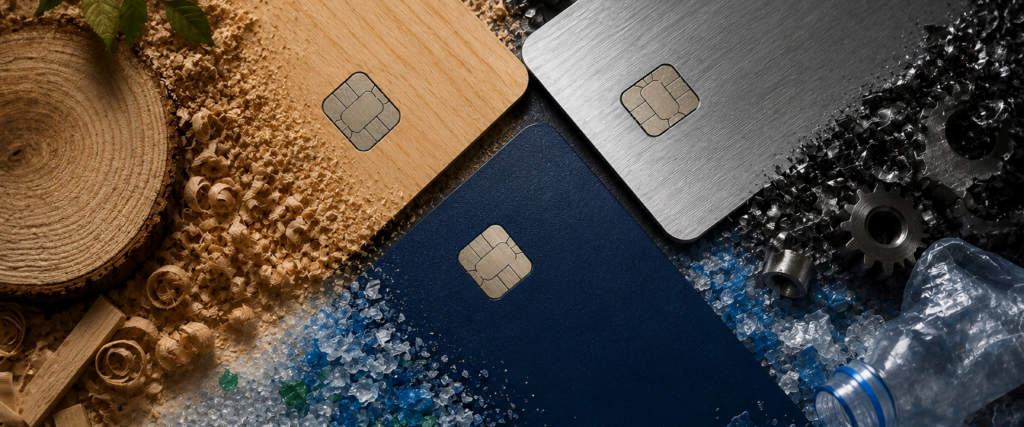
For more than a decade, metal has been the go-to material for premium payment cards. But much has changed in that time—from technology and the environment to how people like to express their personal values. Now, alternative card materials such as wood are challenging what a premium card can look and feel like.
New research from Copecto, conducted by Juniper Research, explores what consumers want from the materials behind the cards they use—and what that could mean for the future of premium banking.
Consumers are no longer judging financial products solely by their functionality. Increasingly, they want products that reflect their personal values. In the research, 67% of UK consumers said it is important that the products they use align with those values. For banks competing for affluent customers, premium can no longer be defined by status alone—it also needs to demonstrate purpose.
Sustainability has become a product question
Sustainability is often communicated through corporate commitments and reporting, but consumers increasingly expect to see it reflected in the products they use every day.
The research found that 63% of consumers believe banks should do more to make their products and services sustainable, while 69% are sceptical of sustainability claims, suspecting greenwashing.
That combination presents a challenge. Consumers want more sustainable products but are less willing to accept marketing messages at face value. A tangible product can communicate those values more effectively than a statement on a website.
This is where the physical payment card still matters.
The physical card remains relevant
As Copecto CEO Ashwini Pandey says: “The more digital banking becomes, the more valuable these physical touchpoints become.”
Among consumers interested in wooden payment cards, half said they would consider switching banks to obtain one.
The card remains one of the few banking products that is carried, handled, and seen repeatedly. It is a reminder of a relationship that is otherwise becoming increasingly intangible.
That makes the card material more than a design decision. It is part of the experience the bank creates.
Metal still says premium. But is that enough?
The research challenges the assumption that metal is the natural endpoint of premium card design.
And that question is beginning to surface more widely across the industry, with both Yahoo Finance and Retail Banker International asking whether premium banking has become too predictable.
Wood performed strongly against metal across several of the attributes tested. Consumers associated it with quality, exclusivity, authenticity, and sustainability. Some 63% perceived wooden products as more exclusive than plastic, while 48% preferred the feel of wood to metal.
The distinction is important. While metal signals premium, wood signals premium with purpose.
That combination appears to have particular resonance with affluent consumers. Interest in wooden payment cards reached between 72% and 76% among consumers earning between £40,000 and £150,000. Among those earning more than £150,000, 43% ranked wood as their preferred card material after learning more about the available alternatives.
This suggests that wooden cards are not simply a niche sustainability proposition aimed at a narrow group of environmentally conscious consumers. They point to something broader: high-spending customers may be looking for premium products that align more closely with their values.
The commercial case is already there
The most interesting finding for banks and fintechs may be that this is not simply a brand exercise.
Nearly half of the respondents surveyed (48%) said they would be likely to upgrade to a paid or premium bank account if it included a wooden payment card. Half said they would consider switching banks to obtain one.
Among consumers who were interested in wooden cards earning more than £150,000, that figure rose to 67%.
Those numbers should be treated with appropriate caution, of course. Stated willingness to switch is not the same as a completed account transfer. But the direction is clear: a physical product can influence decisions that financial services businesses typically try to win through pricing, rewards, features, and digital experience—particularly when it gives customers a tangible way to express what matters to them.
That creates an interesting question for the industry. What if the next premium differentiator is not another benefit added to an account, but a more considered approach to the product customers already carry?
Awareness is the biggest barrier
Perhaps the most significant finding is how little consumers know about alternative card materials.
Before taking part in the research, 56% were unaware payment cards could be made from anything other than plastic, while around 78% had never heard of wooden payment cards.
Once consumers learned that wood could provide a durable and practical alternative, preferences shifted significantly. Wood became the most preferred card material overall, chosen by 34% of respondents. Among consumers earning more than £150,000, that figure increased to 43%.
Rather than waiting for demand to emerge, the industry may simply need to make consumers aware that alternatives exist.