Research into verified account markets reveals a growing fraud ecosystem that helps criminals bypass KYC and gain access to active financial accounts.
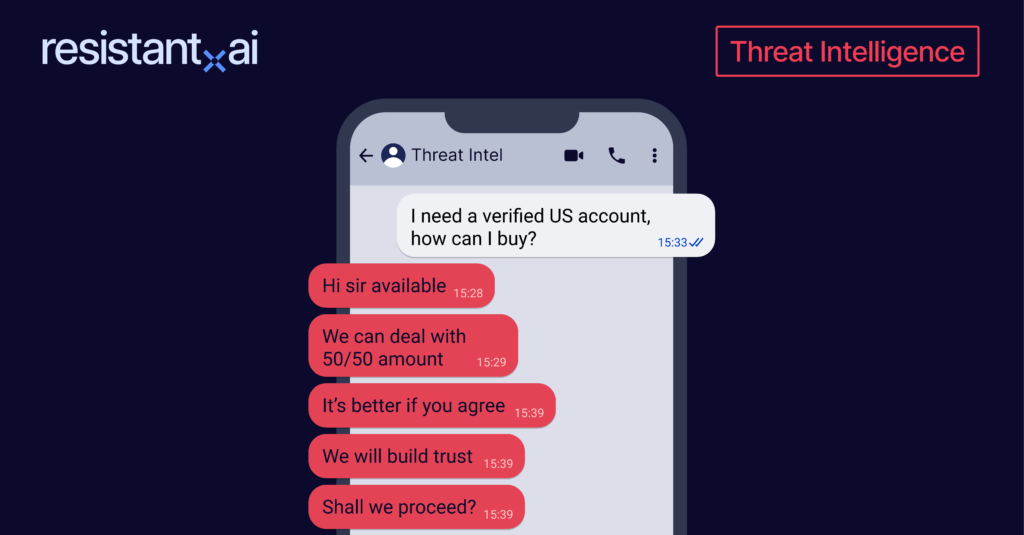
Hi, sir. Available…
…We can deal with 50/50 amount..
…It’s better if you agree…
…We will build trust…
…Shall we proceed?
At Resistant AI, our Threat Intelligence Unit focuses on researching and investigating fraudsters as well as the marketplaces, ecosystems and infrastructure enabling financial crime on a global scale.
For example, we have been systematically tracking and cataloguing template farms (specialised sellers fueling the proliferation and distribution of high-quality, ready-made document templates).
We have also recently been exploring the “verified account” market, an ecosystem full of specialised vendors offering onboarded, active accounts for thousands of financial institutions and other companies across numerous sectors.
But our work isn’t just about monitoring, mining, and exploring data.
We are also continuously embedding ourselves in fraudster communications, testing, and ultimately verifying our data-based hypotheses.
This time around, we decided to test the “verified bank account” market, simply because it wasn’t enough to “just” harvest and analyse without understanding how the crime works practically.
We found that these communities are very much real and thriving in terms of activity and number of people involved.
So this time, we’ll take you on a behind-the-scenes look into how fraud enablers might communicate and how the account market might function overall.
Shall we proceed?
You bet we shall.
Conceptual grounding
Before we walk you through our entire account buying experience, we need to establish the core concepts, logic, and reasoning for this research.
As usual for our Threat Intelligence work, we won’t disclose the names of any specific companies that fell victim to account selling, or the virtual identities of the actors we interacted with.
This is for two main reasons:
- We don’t want to make statements that could damage the reputation of a victimised institution.
- We don’t want to give criminals free advertising, notify them, or otherwise disclose our investigative operations.
Now that that’s established, let’s get started. First, who is actually selling these “verified” accounts? And what does the offering look like?
What is a “verified account” offering?
A “verified account” offering relates to vendors selling accounts that are already onboarded, active and have passed all required KYC checks.
These offerings are being routinely published by an “account farm”.
An account farm is set up by“account farmers” through websites, messaging app accounts or channels, social media pages, web forum threads, or any other channel, forum, or marketplace that allows direct communication with prospective customers.
Examples of account-selling on Telegram, websites and social media
Account farms dramatically lower the barrier to entry for sophisticated financial crime. Instead of investing time and risk into building mule networks, fraudsters can now buy accounts at scale, accelerating money laundering and other illicit activities while making detection and prevention significantly harder.
For several months now, we have been scouring the open web and various Telegram channels to observe, monitor and analyse as many account offerings as possible.
Our webinar on the account farming issue, Money Muling 2.0: Inside the Online Account Farm Economy, is currently available. Read our summary or watch the recording to get a full-context picture of this threat.
But what’s actually in the “verified account” package?
What’s in “the package”?
Based on our own account purchases (so far), the “verified account” package usually contains:
- The account logins,
- Any associated “infrastructure” logins such as an e-mail or marketplace accounts,
- Documentation used for the account onboarding process (IDs, proofs of address, incorporation certificates, tax documentation, social security, etc.)
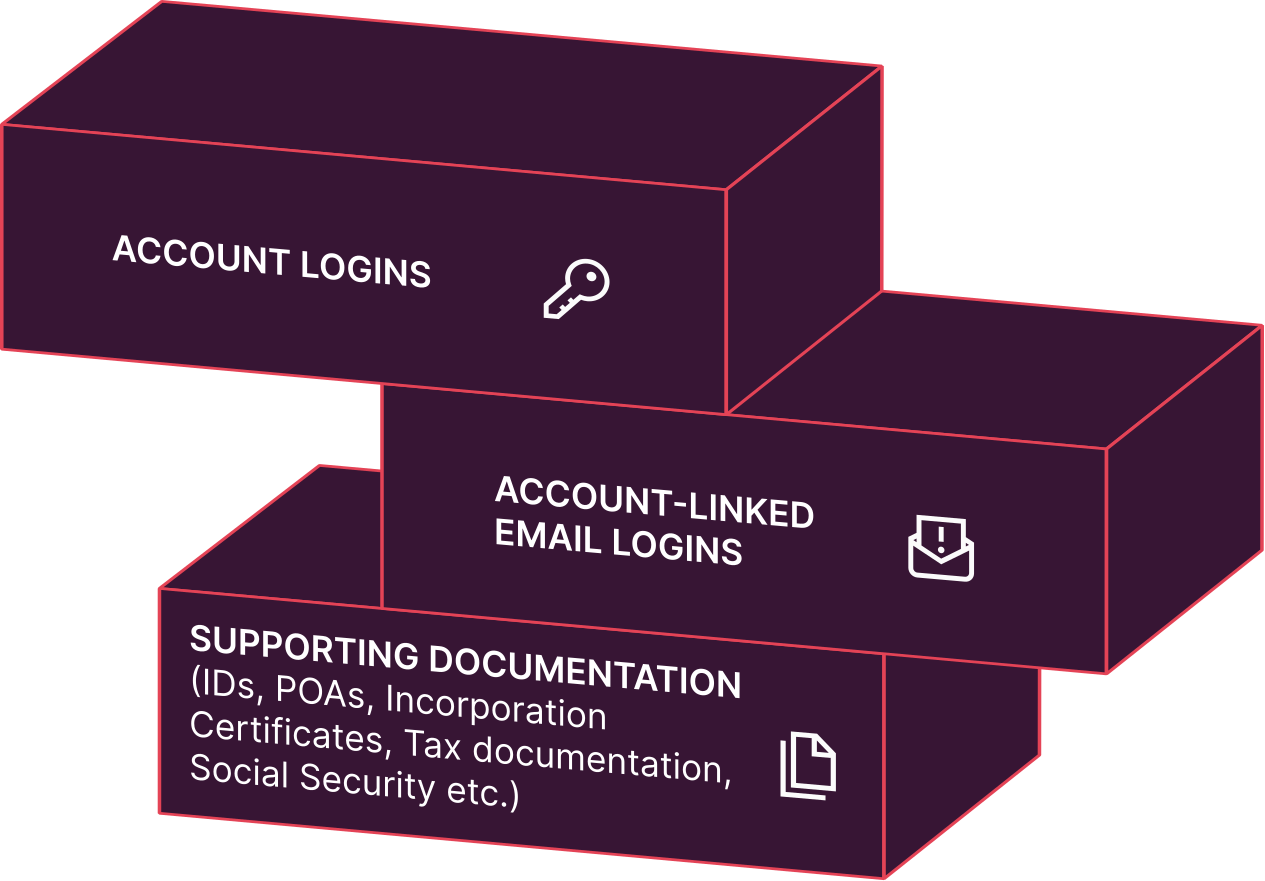
Main components of the “verified account” package include account logins,
account-linked email logins and all supporting documentation
All three package components are essential, as you won’t be able to do much with just one or two. Bought account logins are self-explanatory, of course, but access to other linked accounts such as an email, a marketplace profile, or social media pages is also important:
- E-mail access. Platform providers will often send passwords or verify access to the bought account through the linked e-mail address.
- Marketplace or social accounts. They can help paint a full, albeit fake, narrative of existing business activity.
And, maybe most important, documentation is needed at all stages of bought-account handling, either for additional verification or simply to have all the details used for initial onboarding at hand.
However, account farmers or fraud enablers in general do not stop there. We’ve increasingly seen offerings that imply fraud enablers are pushing the package/service level even further.
How?
A good example is the sale of verified business accounts. In most situations (but not always, unfortunately, but we’ll get to that), you need an existing legal person to start these accounts. Account farmers won’t “just” give you the logins.
They’ll often provide even more complete service, including full company formation (including a provided identity and registered address) and associate marketplace account creation (if it’s merchant-related).
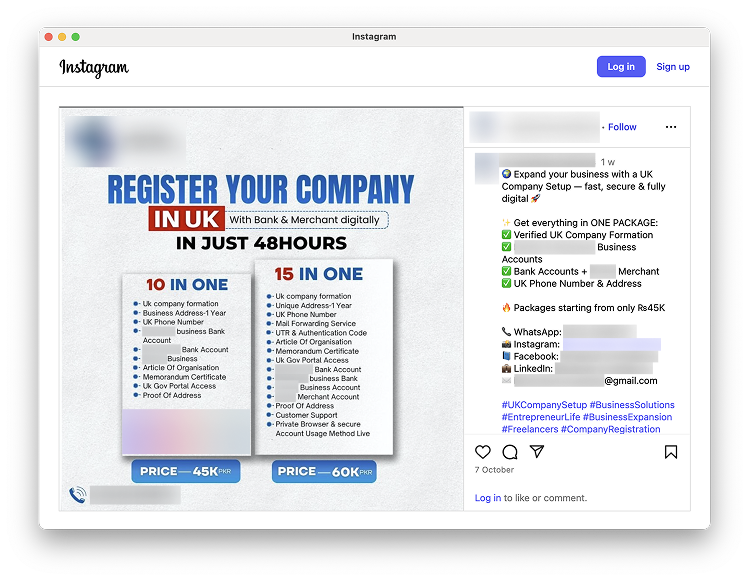
Example of an expanded offering by an account farmer, including company formation and other associated services
Sometimes, they go even further and offer a fake company website or a merchant profile to paint a truly complete picture.
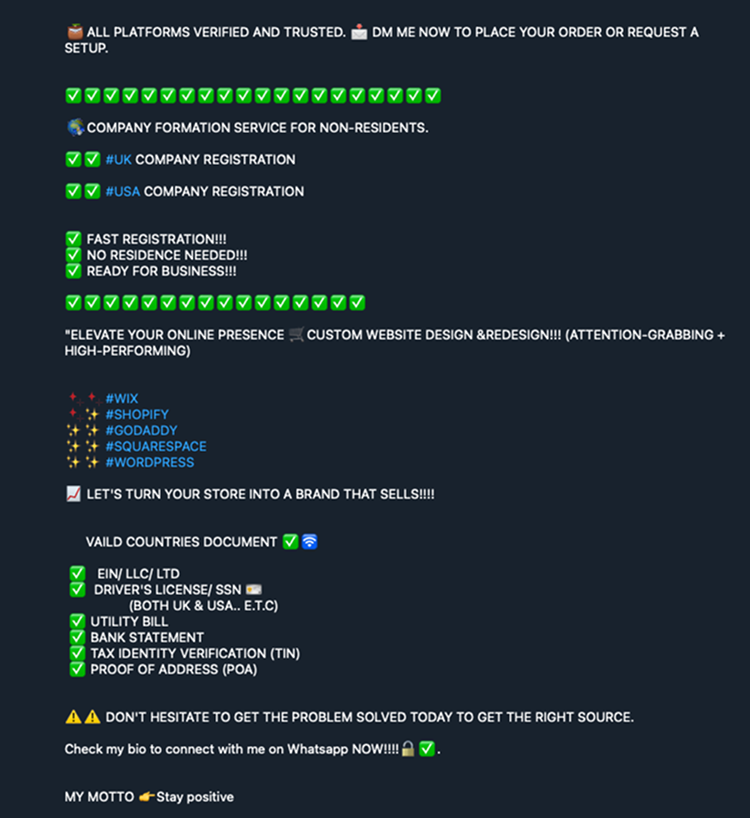
Sometimes, account farmers seem to go as far as to include website design or even
merchant profile creation into the “verified account” package
This further signifies why account farming is a significant piece in the “fraud-as-a-service” puzzle.
That’s also why we focus on all individual components of financial crime strategies: forged documents originating from templates, account selling, and all the supplementary services that might come with it.
Our research shows that financial crime enablers increasingly realise their profit margins may be highest when they supply an end-to-end service, leaving the criminal with only one decision: what crime to commit.
In short, this is not just about template farmers or account farmers. This is a constantly growing ecosystem of commercialised fraud enablers that make financial crime simpler, easier and globally accessible.
Our Threat Intelligence Unit monitors and estimates the size of these ecosystems, and the results are always staggering.
As for the “verified account” market, we have another massive criminal enterprise on our hands.
How big is the “verified account” market?
Our estimates of the “verified account” market size are based only on the datasets we have compiled so far. Even with so much data already captured, we think we might still be just scratching the surface of a much larger network.
So far, we have identified and analysed 100 different “account farm” websites with:
- 3,000 individual “verified product offerings”,
- Accounts from 200 different companies.
This is already a sizable market. But things get much more dire when we analyse account-farming activity on Telegram.
After 1 month of analysing Telegram communications within 55 different channels, we’ve already identified:
- 120k+ unique messages,
- 150k+ individual account offerings,
- 9k+ active users,
- 3k+ companies falling victim to account selling.
Once again – this is only a fraction of what is most likely happening on
a daily basis.
Why such a discrepancy between the website and Telegram high-level stats?
First, websites function as static online stores, meaning the buying and distribution process doesn’t have to include manual inputs or direct communication between the buyer and the seller. In that sense, account farming websites might be the farmer’s dream, as it’s a highly scalable and potentially automated form of account selling.
But there is a caveat. As we’ve experienced during our own account purchases, trust is a major factor in this process, and direct, instant communication between the buyer and seller establishes (at least some level of) trust. The average price of an account is around $350, and even (or especially) fraudsters do not want to be scammed and lose their money for nothing.
You’re not risking just a few bucks like you might when buying a template, and the financial stakes are much higher for customers in the verified account market. You don’t want to enter your payment information on a website and just “wait and see”.
This is why we believe criminals prefer messaging platforms (which thrive on instant, direct communication), and they still get looped into most purchase flows, even when a customer begins his “buying journey” on an account farm website.
Now let’s move on to how we went about our own purchases, and what lessons we learned.
How we found one of “our” account farmers
As stated, we monitor many channels where accounts are sold and have seen hundreds of thousands of offerings unfold in only a few months.
Embedded in one of the more prominent channels with thousands of active users, we chose one of the many banking & payments account offerings, initially focusing on purchasing a business-related account.
Why a business account?
We were interested in the full package, not just access.
That includes supporting documentation, which can be more extensive for business accounts than for personal accounts. Both KYC procedures include personal documents such as IDs, but the business account onboarding also requires corresponding business documentation.
And what about our seller?
Farmers aren’t stupid, and they obviously don’t disclose their real identities or locations.
Our seller is active in 3 of the channels we’ve analysed, claims to be “selling premium business accounts as a 24/7 service”, and lists a French phone number on his profile.
He/she also seems to specialise in US and UK business accounts for numerous digital banks. But this is definitely not the biggest or most visible seller. His profile was“ordinary” among potentially thousands of similar sellers. And that’s exactly why we tried this one first.
Because if an ordinary, small-time account farmer could deliver, chances are high all these other account farmers can deliver as well.
Negotiating, the role of escrow, and the issue of trust
Once we found our account farmer, we moved into a direct conversation.
We expect this to be the standard operating procedure, which helps explain why most channels contained messages focused on selling, not buying, since these channels function as a marketplace where farmers compete while the transaction and distribution happen in private conversations.
Initially, our seller suggested we process the transaction using an “escrow” service, an intermediary that holds funds while a deal takes place.
Today, escrow has been fully digitalised, as online platforms often hold funds during e-commerce transactions, domain transfers, freelance work, and even cryptocurrency deals. Sometimes an administrator of one of the “marketplace” Telegram channels we are monitoring even handles the escrow.
But we wanted to deal with our account farmer straight up, and without any middleman. After a few messages, we agreed on a “50/50” approach: sending half the funds upfront and providing the rest only after we received the full package.
Imagine our concern when, after we sent the first half of the money and the farmer confirmed receipt, he/she went silent.
“Did we just throw our money away?”
An hour went by, and we still didn’t even get our logins.
Asking our account farmer about the holdup, he/she seemed to be stalling:
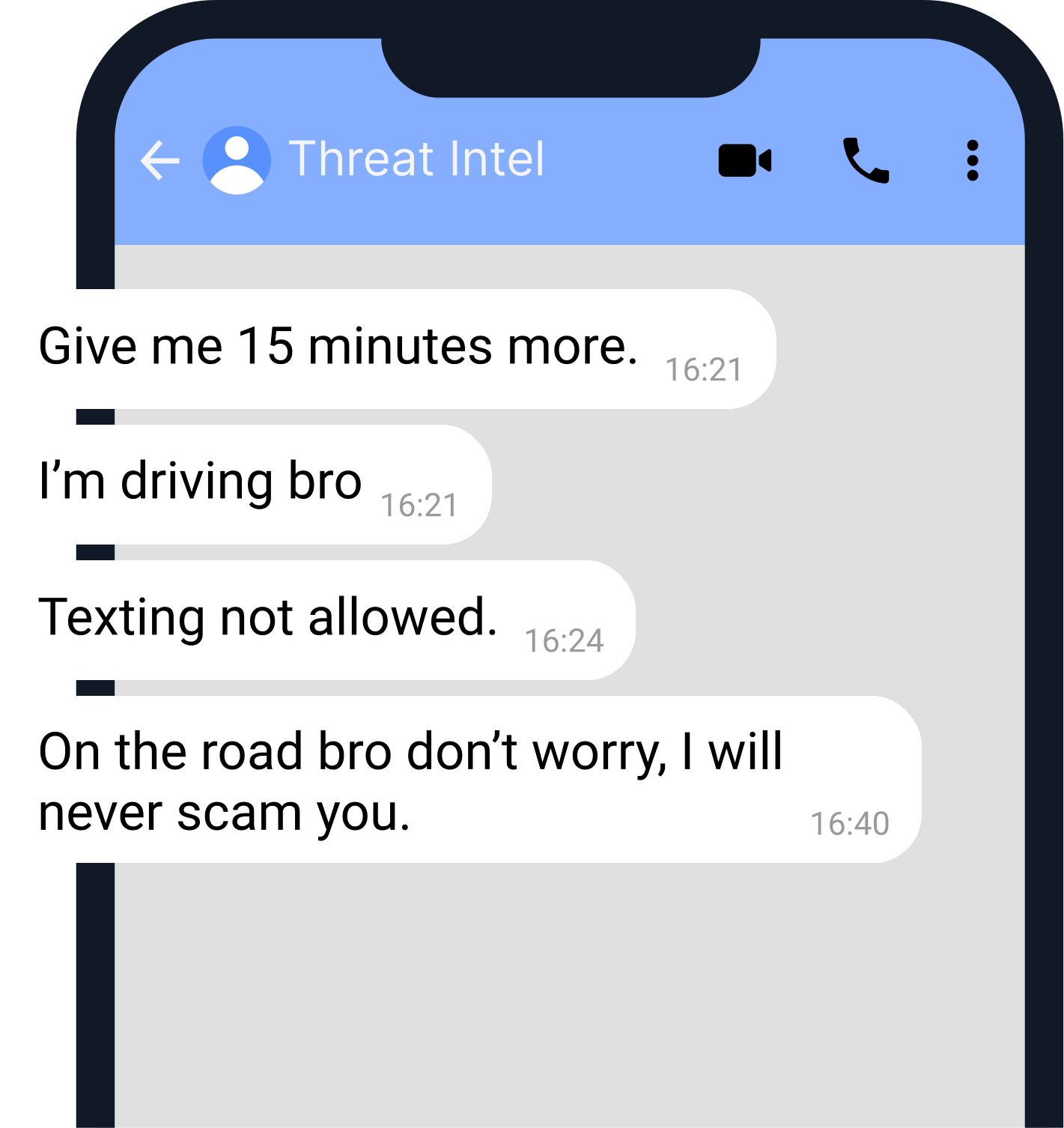
Is there honour among thieves, as they say?
To our surprise, our seller sent us a photo that seemed to be taken from a scooter bike stuck in a traffic jam. Some basic OSINT then placed the seller in a large city in an Asian country.
Was it really a genuine photo? Did the seller not mind if we knew where he was?
It seemed to be the case, as about 2 hrs after our initial transfer, the farmer used our provided phone number to start the account handover.
Bro…
…sending OTP…
…ready?…
The Handover
Unfortunately, right after the handover seemed to have finally started, there was more stalling:
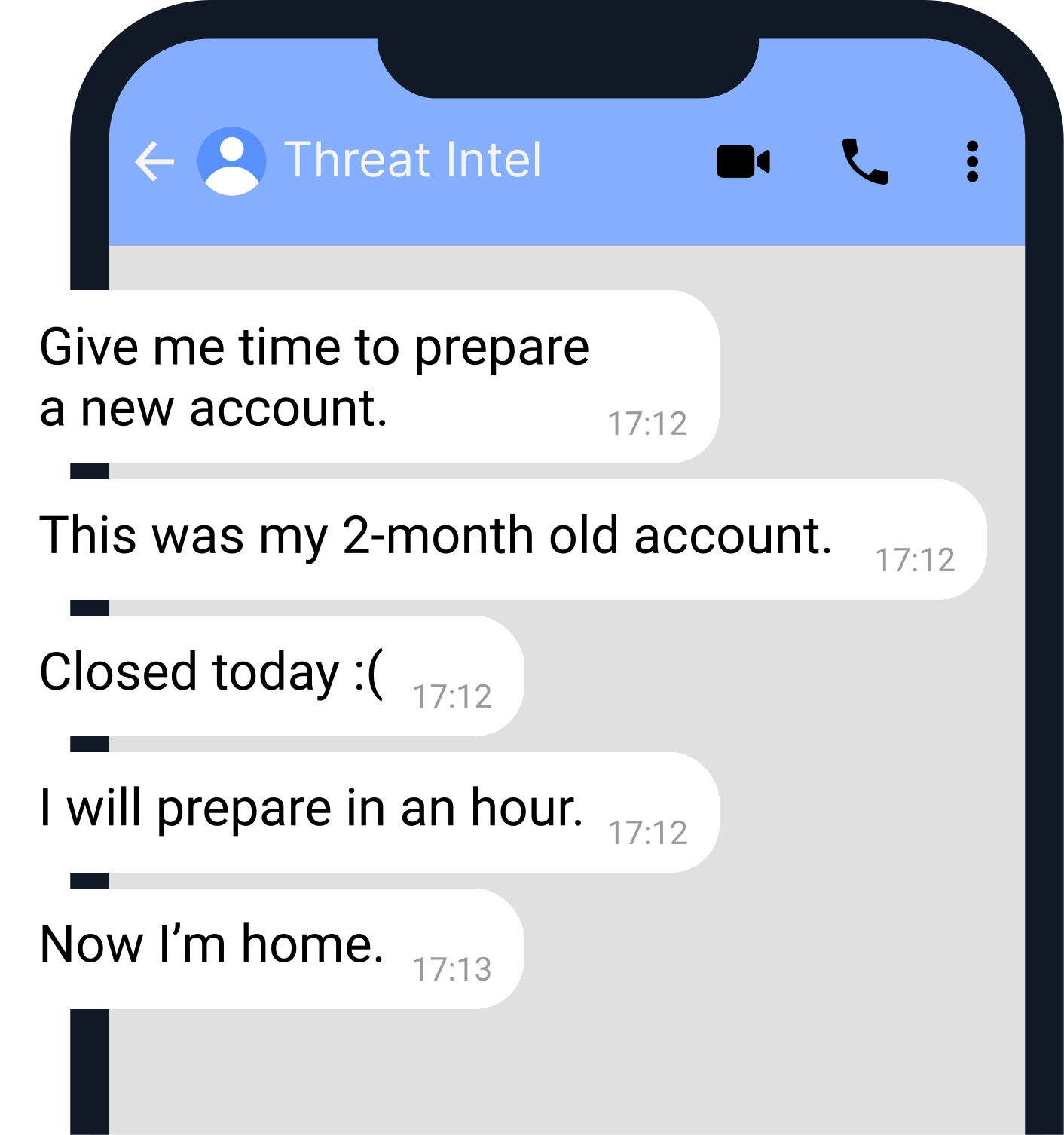
Was this really the case? Again, we were forced to wait and see.
3 hours after the initial purchase, things started moving.
We quickly learned that the first step in the handover process is switching the account-related phone number. Since phone verification is standard and commonly used, the account farmer needs to ensure the phone number switch is efficient (and that the change confirmation is completed right after the OTP is sent).
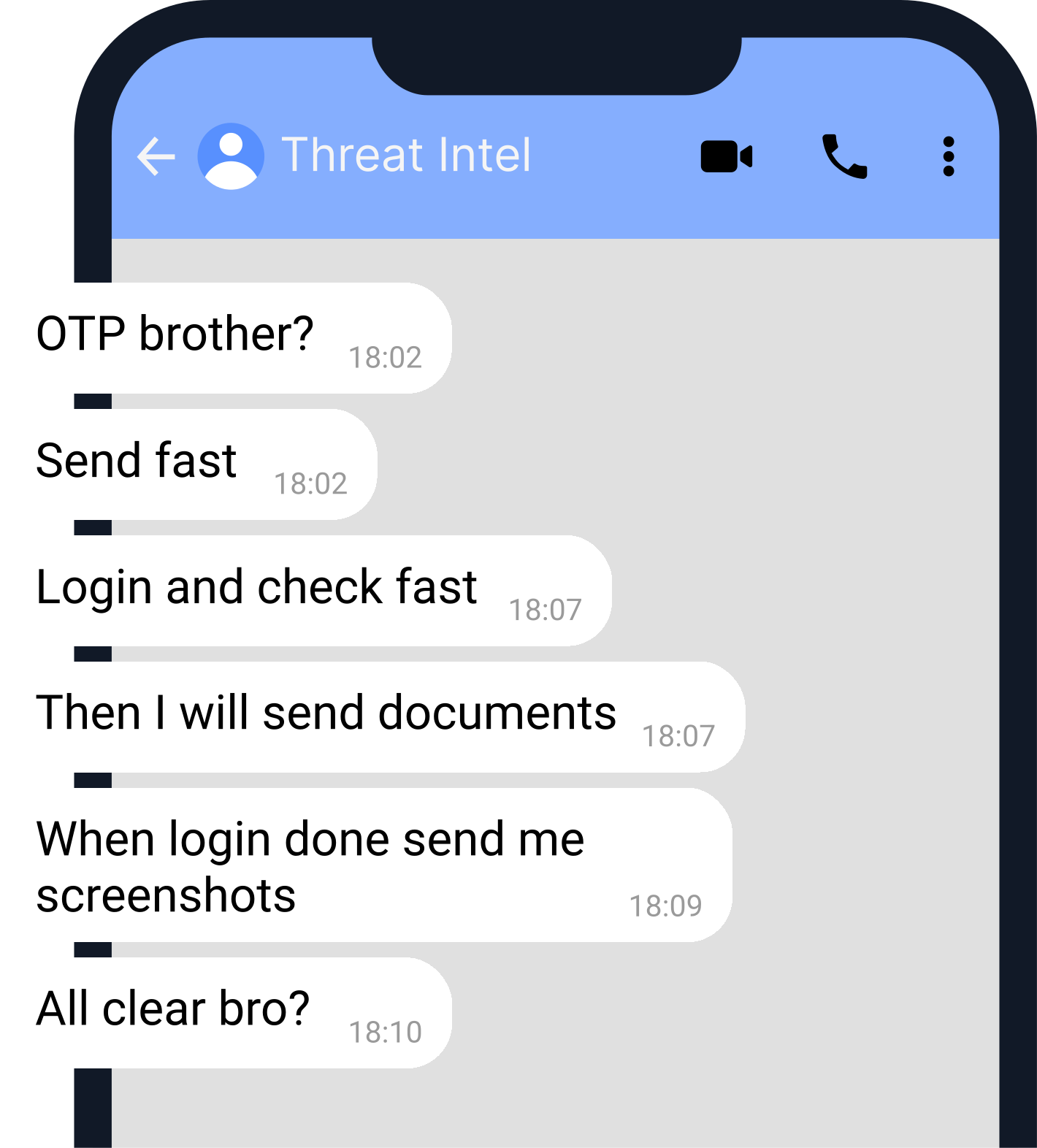
Once the phone was switched, we moved to the login handover phase.
Our seller sent us both the purchased account logins and the associated email logins.
And we did log in. Confirmed login via both phone and email. Case closed.
Funnily enough, the roles switched once we received the logins, and it was now the account farmer who was impatient to complete the deal.
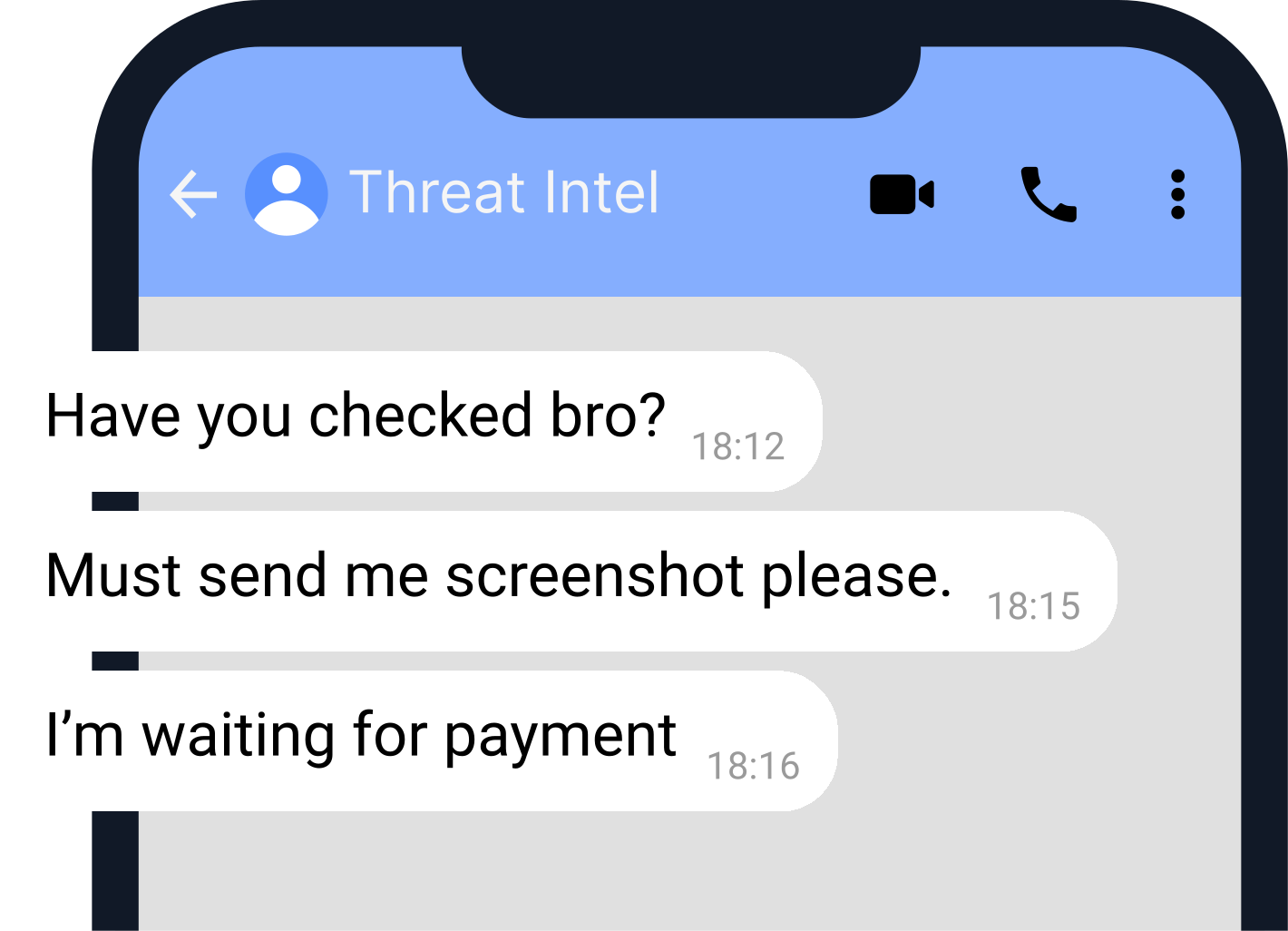
As stated before, we wanted to review the full package, and we did send the second half of the money.
Soon enough, we received some documents, including:
- Company director ID,
- Company Certificate,
- Tax identification,
- Social security identification
After reviewing the documents, it quickly became clear they were all fake.
Even more alarming, the company did not exist when we checked its name in the business registry where it should be filed, meaning this platform had already onboarded a fraudulent company.
But at this point, there was no reason to tell the account farmer, or to keep hassling over the documentation provided.
At the end of the day, the account was live, and we controlled it.
The consequences of a successful verified account purchase
Now we get to the most interesting (and scary) part of our entire account-purchasing adventure.
What does all this mean for financial institutions (and other businesses) worldwide?
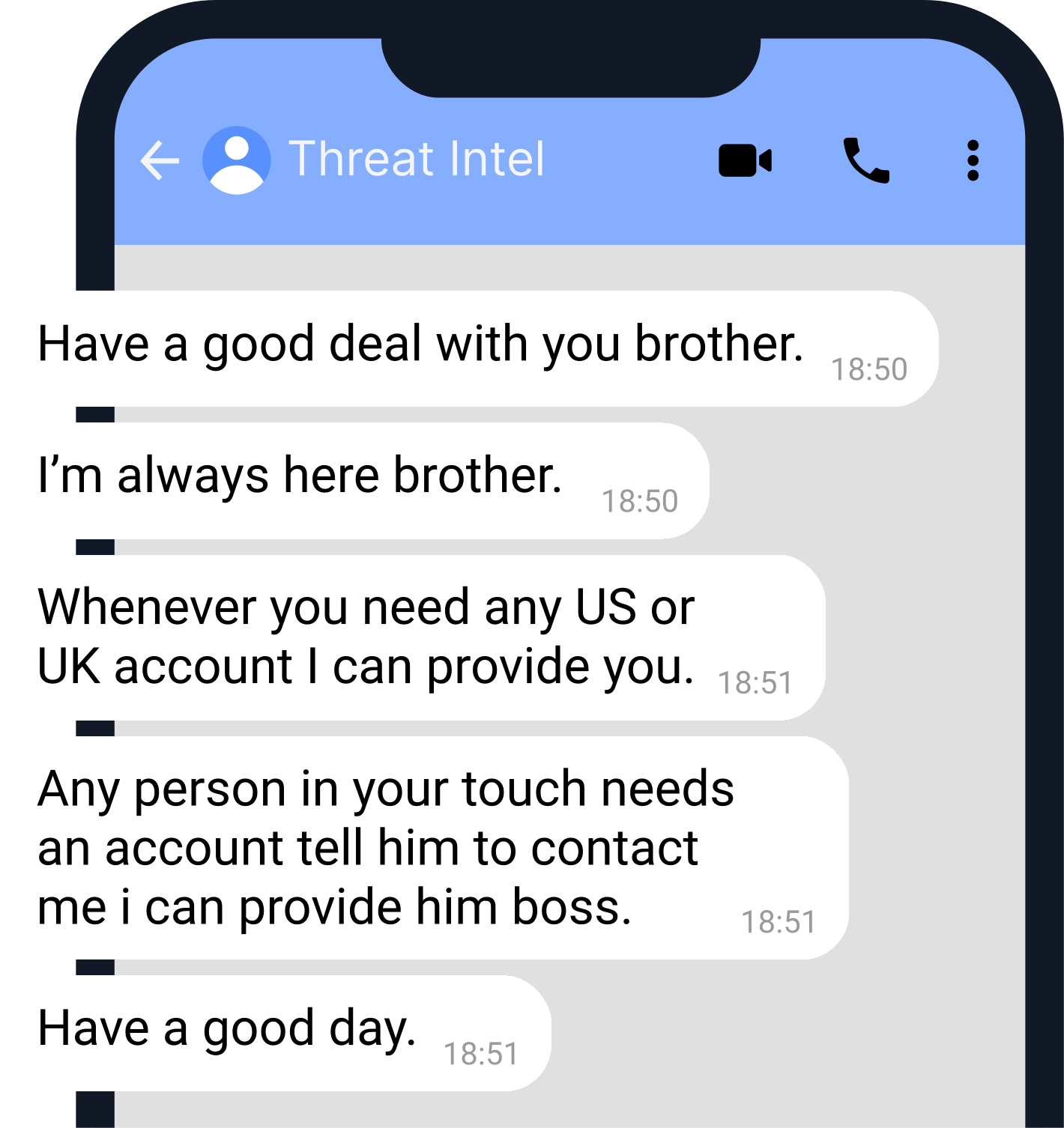
The first and main outcome of our account purchase is validating that at least some (if not most) of these account offerings are real.
Previously, there could have been a notion that the account farming and selling activity could just be another scam – extract the funds, send bogus logins, and cut off communication, case closed. In fact, some financial institutions even claimed this, trying to downgrade the verified account-selling threat altogether.
Not anymore.
Considering some of the high-level stats we mentioned above, even if only half (or even less of the activity we’ve tracked over 1 month proved to be real, the account farming activity would then still be a major threat.
And we know more channels, more sellers, and more accounts are offered daily worldwide, in different languages, to anyone willing to buy.
In short, this threat is very real, and financial institutions need to react accordingly.
How?
Everything starts with understanding how exactly account farmers breach KYC and onboarding processes.
We’re at a point where even extensive documentation requirements (IDs, business documentation, questionnaires, etc.) do not guarantee security. One successful breach and an account farmer “figuring out the formula” then only guarantees repeated attacks.
Using forged documents, leveraging AI generation, or even setting up entire shell companies, fake websites or merchant profiles, the palette of tools and assets provided by professional financial crime enablers is only getting wider and more diverse.
But more on that next time.