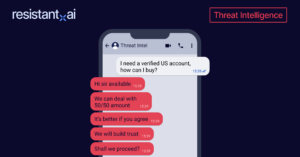

AI-driven fraud has industrialised, forcing the industry to move from awareness to coordinated action on data sharing, accountability, and prevention.
As a company passionate about revolutionising AML credentials, it’s been an honour to expand our offerings in the United Kingdom. The abundant fintech culture has been palpable in our ‘on the ground’ meetups, which we have experienced all over the nation–finding actionable solutions to address the most concerning forms of financial crime in the UK, and beyond.
From this year’s exceptional MoneyLIVE conference to another of our inaugural private events, nothing beats convening person-to-person and understanding the genuine impact our collaborations with friends, partners, and fraud and compliance experts have on financial services.
The picture of AI-driven fraud
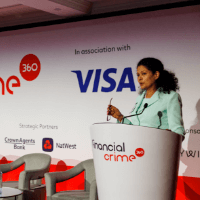
In March, our team hit the exhibition floor at the MoneyLIVE Summit for the second time. Having won Best Use of Emerging Technology last year, this time around, we wanted to create an even bigger splash with our risk-spotting interactive claw machine stand and panel talk addressing the very real role of fraud as the first fully automated economy.
As CEO of RelyComply, I was honoured to be joined by Rish Tandapany (COO at Purple Group) and Leon Ifayemi (director of coalitions and research at CFIT) discussed modern AI-led fraud trends rocking the industry: the democratisation of GenAI and its global fraudulent use; how to counteract its speed and scale through proactive monitoring and authoritative data sources; cultural and systemic changes to unified compliance frameworks; and collaboration around digital ID verification.
The conversations we had were eye-opening, but it’s reassuring to know that the wide-ranging fraud implications were being challenged by financial institutions, law enforcement, tech providers, and sector experts, turning academic reasoning into action.
Growing incentives for our industry
These themes bled into our second ‘Topics Left on the Table’ private event in London, bringing the lesser talked-about financial crime compliance issues to the fore, away from the main event stages. Last year, we were glad to bring speakers Gareth Dothie (former City of London Police detective) and behavioural investigator Dr Roger Miles alongside figures representing, among others, Tide, Uber, Santander, and OakNorth.
At this year’s COYA event, we welcomed senior leaders from commercial banks, wealth management, and payment technologies to the conversation with MasterCard’s Conrad Lennard and Anna Rowe from the fraud centre and think tank Lovesaid. The inescapable issue was how we’re navigating the seismic human and economic effects of ‘industrialised’ digital fraud, and how the UK’s 40-60% increase in losses – from payment card and remote banking fraud – contributes to financial crime becoming the third-largest economy in the world.
As we collectively deduced, that cost (a doubled figure compared to a decade ago) is a result of criminals getting more numerous and opportunistic – hidden behind computer screens and the darkweb, operating out of SIM farms, utilising stolen identity kits and ‘fraud as a service’ companies, and developing GenAI techniques to steal and launder obscured funds in scalable enterprise-like ways.
It’s not just digital abilities that criminals are getting craftier at. Worryingly, their psychological manipulations now operate as gateways to further financial crime. They target vulnerable people with fake promises through investment schemes or dating apps, recruit them as mules, or repeatedly offend via unreported toxic relationships that drain victims’ life savings to fund other criminal enterprises (including crypto scams).
Such coercive criminal acts are traumatic, transferring narcissistic abuse to a financial context. When social media and dating apps, payment providers, and banks have poor data security and authentication controls, they essentially enable AI-generated media and fraudulent accounts to win.
As criminals are driven by motives, so too must there be a more forceful incentive for institutions to be compliant and to educate and protect their consumers from making dangerous choices. Until such platforms are held accountable, victims will be exploited. We need to reposition the conversation so that institutions do not feel constantly penalised, but rather empowered to know that their increased detection can proactively stop abuse.
RelyComply’s next stages
Thank you to everyone who attended and contributed to the valuable discussions, as well as to all our partners and new connections we caught up with at PAY360—you are truly pushing the industry forward on anti-fraud matters that mean a lot to us all.
We will be in Edinburgh in April for the BSA Conference and will be holding more insightful expert talk editions in London that put a wonderfully British spin on discussions about the future of financial crime for banks and payments.
If you’re interested in our next private UK events as a senior-level individual working in RegTech and AML compliance in the financial industry, please reach out to [email protected], where availability will be first-come, first-served. We can’t wait to hear from you and keep driving AML compliance momentum!