AI-powered search is reshaping discovery. As buyers turn to tools like ChatGPT, payments firms must rethink visibility beyond search and social.
For years, digital advertising has been dominated by two channels: search and social.
Now, a third contender is beginning to emerge: advertising inside AI-powered conversations.
That matters for payments businesses because the way people research financial products, compare providers and shortlist technology partners is changing. A future buyer may not begin by searching Google for “best payment gateway” or “fraud prevention software”. They may ask ChatGPT to compare options, explain the differences, and recommend providers based on their specific needs.
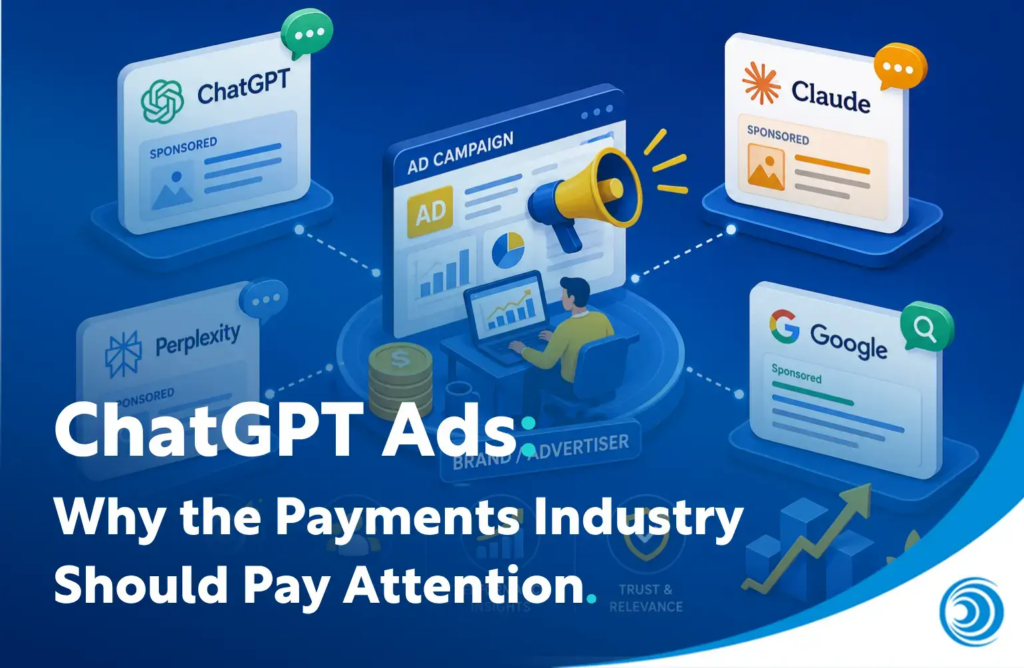
OpenAI’s rollout of ChatGPT Ads marks one of the first major moves towards paid placements inside a mainstream generative AI platform. While still in its early stages, the launch signals a broader shift in how brands may need to appear across the customer journey.
For businesses across the payments ecosystem, that’s worth paying attention to.
A new advertising channel is taking shape
ChatGPT Ads may be new, but early adoption has been rapid.
Sensor Tower data, provided to The AI Ad Economy, reported more than 1,400 brands had advertised on ChatGPT in the US by late May 2026. Earlier Sensor Tower data also suggested a sharp ramp-up; during the platform’s rollout, ad volumes reportedly increased by 600%, while industry monitoring has identified more than 50,000 daily placements.
Earlier Sensor Tower data also suggested a sharp ramp-up in March, with ads reportedly reaching around 5% of ChatGPT mobile users by mid-month, up from roughly 1% at the start of the month.
Those figures suggest that AI-powered advertising is quickly moving beyond experimentation and establishing itself as a credible channel for brands looking to reach audiences in new ways.
Why does this matter?
Consumer behaviour is changing.
Increasingly, people are turning to AI platforms to research products, compare services, answer questions, and seek recommendations. In many cases, those journeys would previously have started with a Google search.
Research from OpenAI, Harvard University, and Duke University found that. Almost a quarter resembles traditional search behaviour. It also found that most ChatGPT use falls into practical guidance, information-seeking and writing, with the authors highlighting its role in decision support.
For fintech marketers, that represents a valuable moment of intent.
What makes ChatGPT different?
The key difference is the user experience.
Google presents a list of options. ChatGPT provides an answer.
Users can ask follow-up questions, refine requirements, and compare solutions within a single conversation. For advertisers, that creates opportunities to engage people based on context and intent rather than a single keyword search.
It’s also what makes ChatGPT Ads different from most other AI platforms. While OpenAI has embraced advertising, competitors such as Claude remain ad-free, and Google has denied current plans to place ads directly inside the standalone Gemini app, although it is already developing Gemini-powered ad formats across Search and AI Mode.
What does this mean for payments businesses?
Whether you’re a fintech, payment service provider, bank, software vendor, or technology partner, AI is becoming another place where buyers conduct research.
Future customers may increasingly ask AI platforms to compare payment providers, recommend software, evaluate fraud solutions, or explain emerging technologies before ever visiting a website.
We’re already seeing financial institutions embrace this transition. On the 30th April 2026, NatWest became the first UK bank to launch home-buying guidance within ChatGPT, allowing users to explore mortgage and remortgaging options through one of the world’s most widely used AI platforms.
While not an advertising initiative, it demonstrates how AI is beginning to reshape how financial services organisations engage with customers, provide information, and support decision-making.
That has implications beyond advertising.
As AI becomes a more common source of information and recommendations, businesses must also consider how visible they are within AI-generated answers.
Looking ahead
ChatGPT Ads may still be in their infancy, but they point towards a broader shift in how quickly the format will mature or how widely advertisers will adopt it.
Exactly how AI advertising develops over the coming years remains uncertain. What’s already clear, however, is that AI platforms are becoming part of the discovery and decision-making process. For payments businesses, that means visibility can no longer be thought of only in terms of Google rankings, paid search, social media or trade media coverage.
The next challenge is understanding how your brand appears when buyers ask AI platforms for guidance, comparisons and recommendations.