Finastra explores how embedding AI-driven fraud detection into payment workflows can help banks and PSPs identify threats in real time and protect customer trust.
Payments are faster, more connected, and increasingly real-time. For banks, non-bank financial institutions, and PSPs, that creates opportunity but also greater exposure to increasingly sophisticated fraud. It is also driving a fundamental shift: fraud prevention is moving beyond a compliance requirement to become a strategic business capability—one that supports the safety, confidence and reliability customers expect.
With high-value payments, a single fraudulent instruction can result in significant loss. With instant payments, the challenge is speed: the faster payments move, the less time you have to intervene. Once a payment has been executed, there may be little opportunity to recover the funds. That speed can also affect customer trust. According to a recent McKinsey study, 77% of customers surveyed would leave a payments provider if they fell victim to fraud or scams. Fraud isn’t just a security issue; it’s a customer retention issue. Without a strong fraud offering, institutions risk losing customers to competitors that can protect them better.
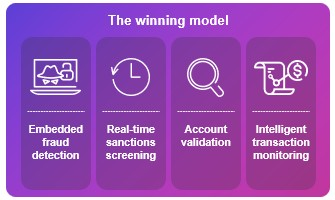
Historically, fraud controls were often applied before or after payment processing. But when transactions settle in seconds, checks performed outside the payment workflow can create operational and compliance risk. Banks and other institutions increasingly need fraud monitoring, sanctions screening, account validation and intelligent transaction monitoring embedded directly into the payment flow, enabling faster decisions and stronger protection without sacrificing speed.
This shift is part of a broader transformation in how banks and other institutions connect, process and protect payments. Finastra’s new eBook, ‘Financial Messaging at a Tipping Point‘, developed in partnership with Datos Insights, explores the forces reshaping financial messaging—and what institutions need to consider as speed, interoperability and security become increasingly interconnected.
Protect the payment before it leaves
Finastra Financial Messaging offers an AI-driven fraud prevention tool powered by its partner FraudAverse, bringing fraud detection directly into the payment flow.
The solution analyses account behaviour and transaction data in real time to identify known and emerging threats and can block potentially fraudulent payment instructions before they leave the institution.
For SWIFT payments, pre-configured AI risk models can monitor messages including MT101, MT103, MT202 and MT202COV, identifying anomalous or potentially fraudulent activity before suspicious messages are transmitted.
Some potential benefits of this approach include:
- Up to 99% fraud detection compared with rules-based systems
- 83% reduction in false positives
- 75% reduction in fraud losses
- 93% less time spent investigating fraud alerts
- And processing latency of up to 10 milliseconds per transaction
Protection at payment speed
As high-value and instant-payment volumes grow, fraud prevention can no longer sit adjacent to the payment process. It must be built directly into it.
By bringing intelligent, real-time fraud detection together with payment connectivity, Finastra Financial Messaging can help banks, NBFIs and PSPs strengthen protection while maintaining the speed customers increasingly expect. Institutions that combine instant payment capabilities with robust, embedded controls can deliver more secure and trusted payment experiences—and turn fraud prevention into a meaningful competitive differentiator.
Because when money moves in seconds, identifying fraud after the payment has gone is already too late.
For more information about Finastra Financial Messaging, visit our website.