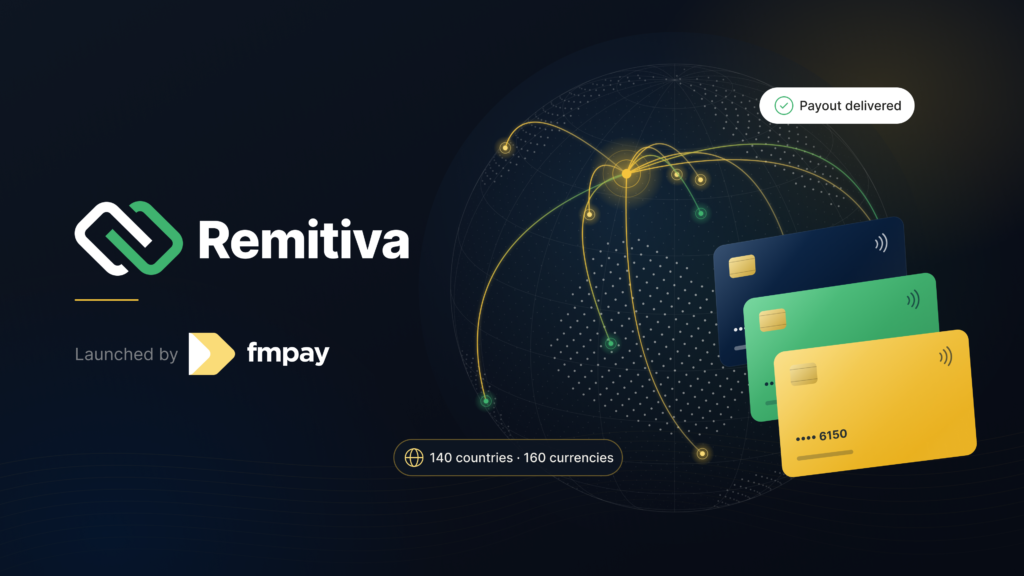
FMPay has launched Remitiva, a standalone card payout service offering near-instant payments across 140 countries and 160 currencies.
For most digital businesses, accepting a payment has quietly become the easier half of the job. Moving money out is where friction accumulates: recipients wait days for funds, fees are difficult to itemise in advance, and a mistyped IBAN can take days to come back.
The gap is documented. In its 2025 progress report on the G20 cross-border payments roadmap, the Financial Stability Board found that only around 35% of cross-border retail payments reach the recipient within one hour, against a target of 75% set for 2027, a deadline the FSB itself now calls unlikely to be met.
Market structure adds a second layer to the problem. Payouts are rarely sold as a product in their own right. They arrive as a feature inside something larger: an add-on to an acquiring platform, a module in a banking suite, a line in an HR system. The tooling is built and prioritised around someone else’s core product, and businesses for whom payouts are the core feel that daily. For platforms whose sellers, drivers, and creators expect to be paid when the work is done, payout speed has become a competitive issue rather than an accounting one.
Remitiva, launched by FMPay as a standalone brand at remitiva.com, targets exactly that gap: instant card payouts as the entire product.
Payouts as a product, not a feature
Remitiva sends funds directly to Visa, Mastercard and UnionPay cards through the schemes’ push payment rails: Visa Direct, Mastercard Send and UnionPay International Money Express. Payouts reach cards in 140 countries and 160 currencies, and funds typically land within minutes, including on weekends and holidays. Recipients do not need an app, an account or bank details. The card number is enough, and the sender’s brand name appears in the recipient’s banking app.
The decision to build a separate brand came from a product observation rather than a marketing one: the audiences barely overlap. A gig platform paying thousands of couriers weekly needs batch tooling, currency conversion and payout reliability; it has little use for subscription billing or chargeback management. A merchant using FMPay for card acceptance rarely needs reach to 15 billion card endpoints. Keeping both jobs inside one product meant one generic roadmap serving two different audiences. Separating them gives each side its own team and its own product plan, on the same regulated infrastructure and scheme memberships.
“We watched two very different audiences share one roadmap for a while, and both were waiting longer than they should have. A platform that pays thousands of people weekly thinks about payouts all day. It deserves a product built by a team that thinks about payouts all day too. That is really all Remitiva is,” says Roman Loban, managing director and founder of FMPay
Expanded FMPay coverage across the UK and EU
Behind the new brand stands an expanded regulatory footprint. FMPay, a boutique acquiring partner for mid-size digital businesses and fintechs, operates under two authorisations: FM Finance (Malta) Ltd, an MFSA-authorised payment institution in the EU, and FM Finance Ltd, the UK company, FCA-authorised as an acquirer (reference 815137). The group is a direct principal member of Visa and Mastercard, with UnionPay membership on the payout side.
For clients, the dual coverage is practical rather than corporate. It determines which entity contracts with a business, where settlement happens and which regulatory framework a setup is designed against: UK entities under FCA supervision, EU-facing businesses under the Maltese licence, and groups with both footprints through a single commercial relationship. After Brexit, that reach is a routing decision with commercial consequences, not a corporate detail.
Automation, with named people above it
Across both brands, the operating model is the same. FMPay describes it as a Human Layer: automation processes the standard flow, and named specialists sit above it. Every client works with a dedicated expert who follows the account, provides visibility into performance against scheme and acquirer expectations, and raises upcoming changes in conversation rather than notification. One structural fact underpins the model: because the group sits in the settlement chain itself as a principal member, rather than routing through a sponsor bank or an aggregator, pricing can be shown at interchange level, and the party a client contracts with is the same party the card schemes hold accountable.
Who Remitiva is built for
Remitiva’s focus falls into three groups:
- fintechs: money transfer operators, digital wallets, B2B payment providers and insurtech, which can take the payout engine white-label and plug it into their own product;
- platforms and commerce: gig economy platforms, creator platforms, marketplaces and online retail, where cross-border card payouts embed as a layer into an existing financial and treasury setup;
- employers with distributed workforces: global employment agencies, maritime and logistics operators, construction companies, hospitality chains, and IT and media production teams paying people across countries and banking systems.
Typical use cases range from mass payouts, commissions, and royalties to fast refunds, loyalty rewards, reimbursements, and VAT or tax refunds.
The through-line
Remitiva’s value logic is simple. The card number a business already holds becomes the only recipient data it needs; dozens of local banking rails collapse into one; and payout speed stops being a back-office cost and becomes part of the offer to sellers, drivers and creators. The conviction behind it is the same one that shaped the group’s earlier writing on risk models: automation is not the problem. Payments run on automation, and they should. What the market is missing sits above the automation: people close enough to an account to interpret what the data means for that specific business, and reachable by the businesses the data describes. A new brand is, in the end, one more place to put expertise next to the complexity.